Howdy Austin,
For folks who love trees and Austinites old and new it’s hard to not take notice of our ever changing landscape in the hill country.
The damage done by the 2021 freeze, the 2022 drought, the 2023 freeze, development and a myriad of other living and non-living (abiotic/biotic) factors are contributing to the apparent canopy loss of our urban forest.
It is easy to drive around Austin and see almost fully dead Arizona Ash (Fraxinus velutina) looming over homes or completely falling apart on consecutive lawns.
Or maybe you’ve been a witness or even had a “close call” with a limb failure of one of our local favorites: the pecan (Carya illinoinensis), hackberry (Celtis laevigata), cedar/American elms (Ulmus crassifolia and Ulmus americana) or even an assortment of red and white oaks.
If you recall February 2023, there was an abundance of limb and tree failures all throughout town due to the addition load/weight added to trees from the accumulation of ice. The city was hit hard for a few days and the crews I was a part of were cleaning crowns for the remainder of the year.
During my field assessments as a certified arborist, I noticed that a lot of the calls and customer concerns were pretty similar in nature. They typically were worried about obvious defects like cavities, overextended branches of property and definite decay indicators such as fungi that they had observed.
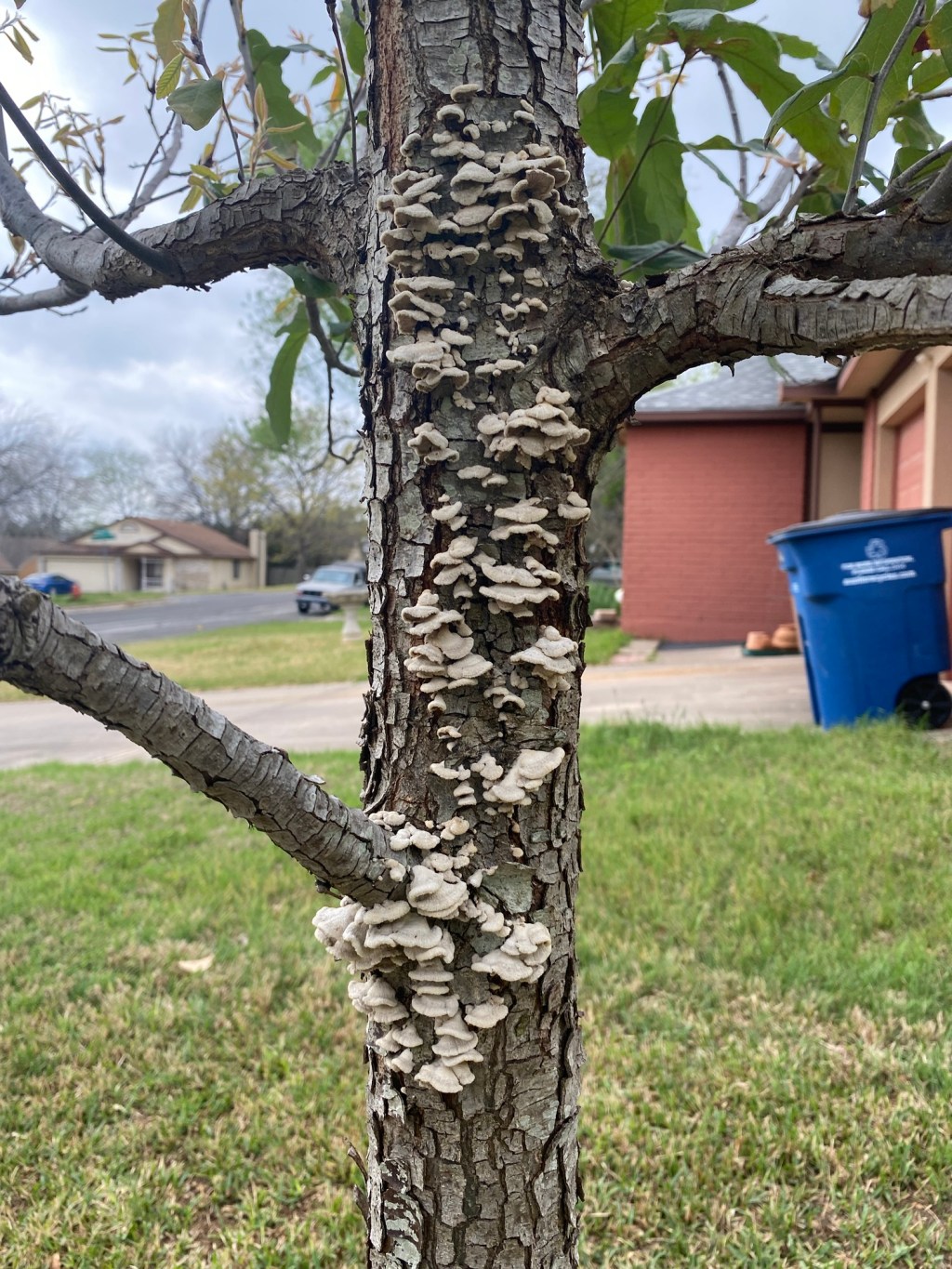
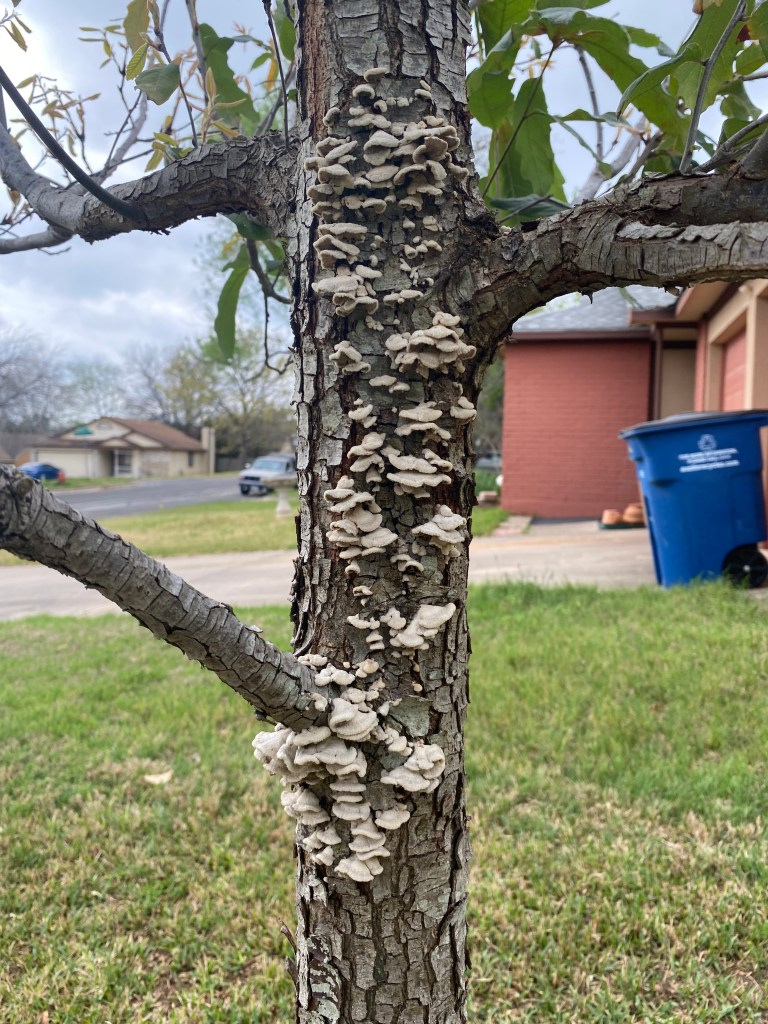
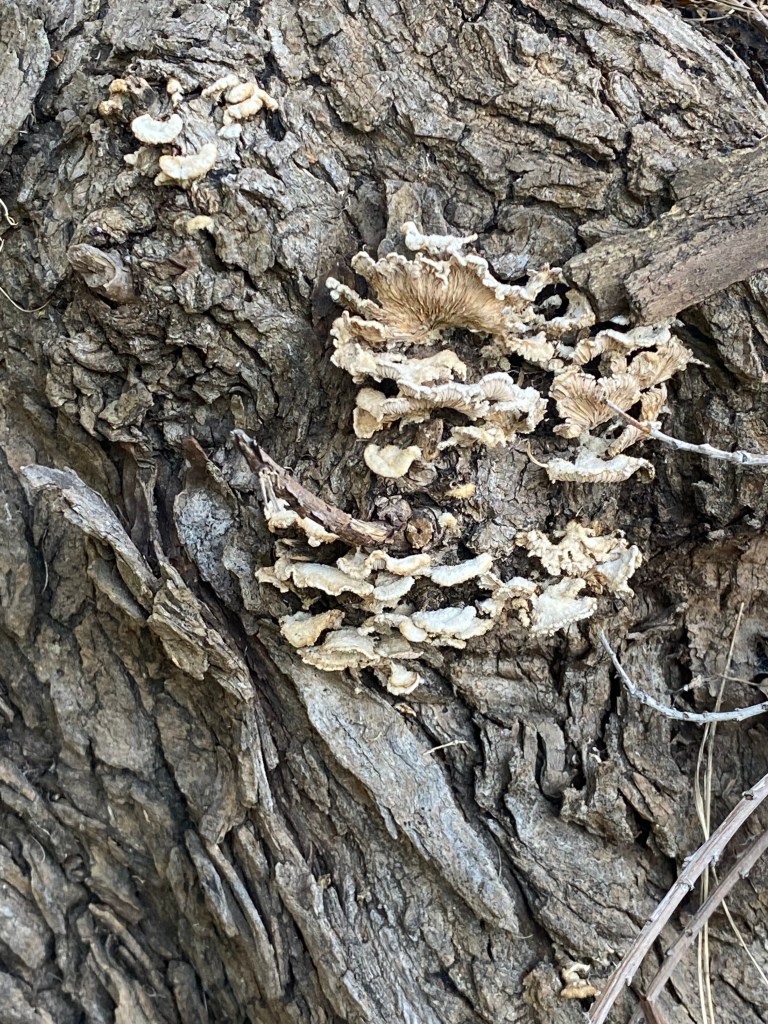
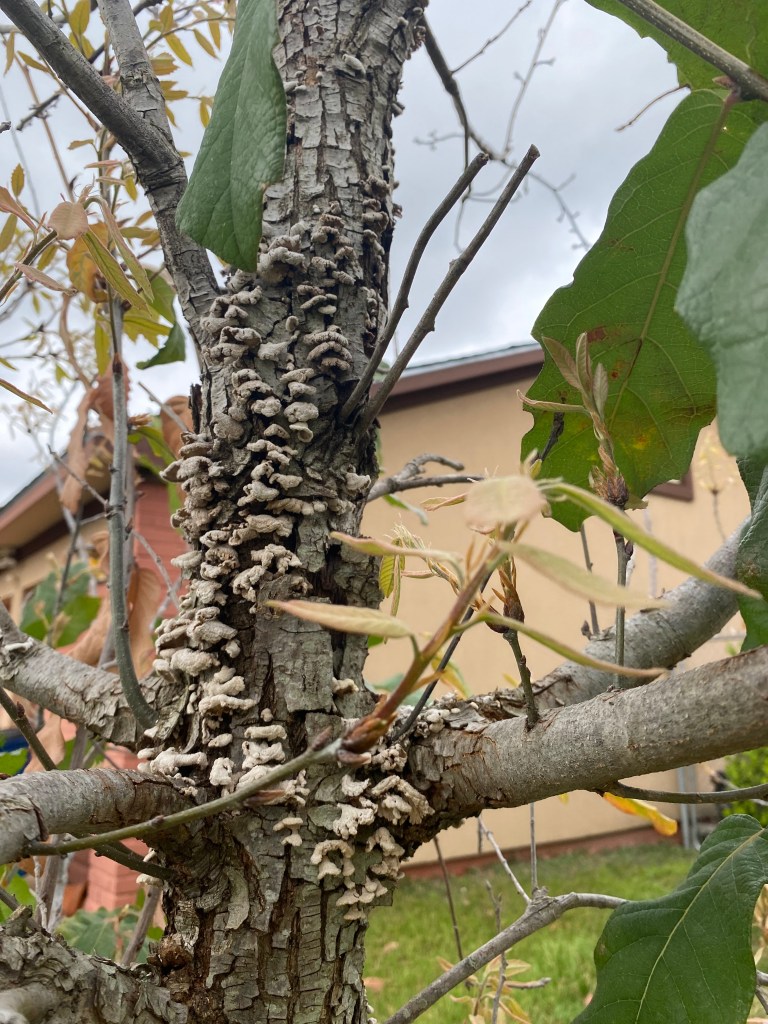
Frequently, I came across these small inconspicuous white mushroom caps located in clusters along the trunks or branches of young trees and many times on oaks in general.
These assessments were often about oaks because we love our oaks out here so much!
For simplicity, I would like to focus on oaks as 2 groups (red and white) but not exclude other types in the area which I have not personally observed with this type of fungal infection.
Also for specificity, I have avoided using common names for the following oaks to avoid confusion.
Some common red oaks in the area I have observed are: Quercus rubra, Quercus velutina, Quercus palustris, Quercus nutallii, Quercus shumardii, Quercus falcata, Quercus buckleyi, Quercus texana, Quercus marilandica, Quercus nigra.
Some common white oaks I have observed are: Quercus macrocarpa, Quercus alba, Quercus stellata, Quercus gambelii, Quercus muehlenbergii, Quercus virginiana, Quercus fusiformis, Quercus laceyi and Quercus polymorpha.
Regardless of the zip code or part of town it seemed like this small persistent mushroom accompanied trees that were experiencing a typically higher degree of stress or decline.
After consulting with some mycologists and attending the 2022 ISA Texas tree conference, I realized this common type of fungal infection many Austinites were and are concerned about is an inconspicuous fungus commonly known as “split gill fungus” or “Schizophyllum commune” by its scientific name.
Split gill is actually one of the most ubiquitous and common types of tree fungus found in the world according to Dr. Lully in his book “Wood Decay Fungi- Common to Urban Living Trees in the Northeast & Central United States”.
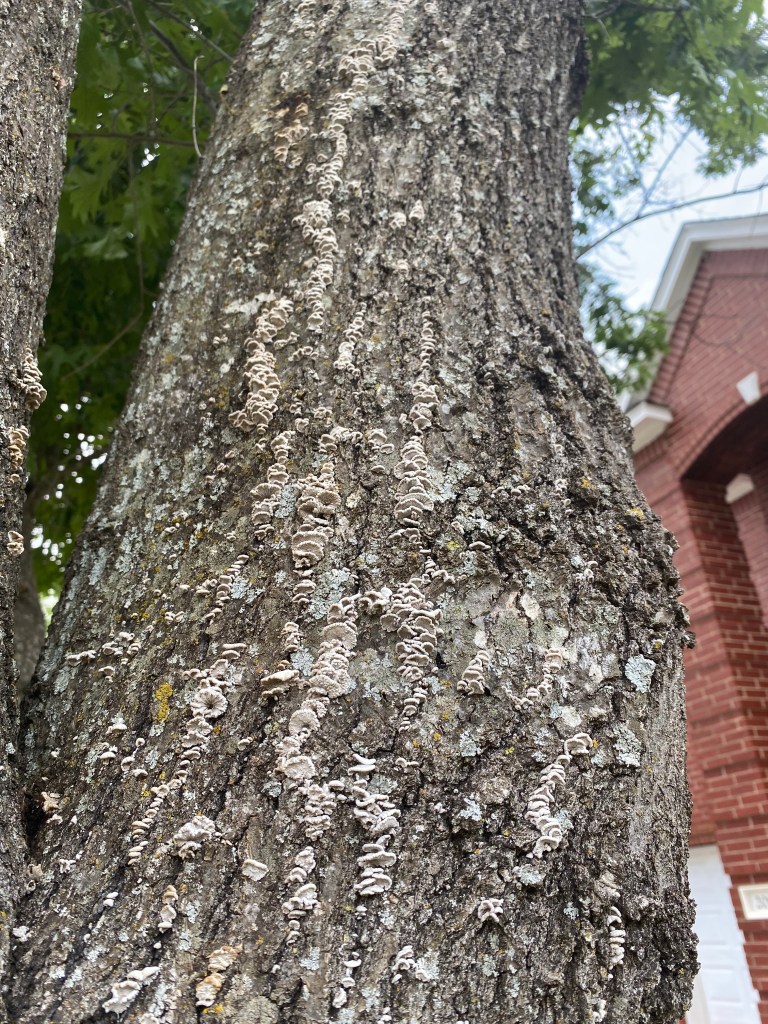
This is split gill colonized on a red oak branch.
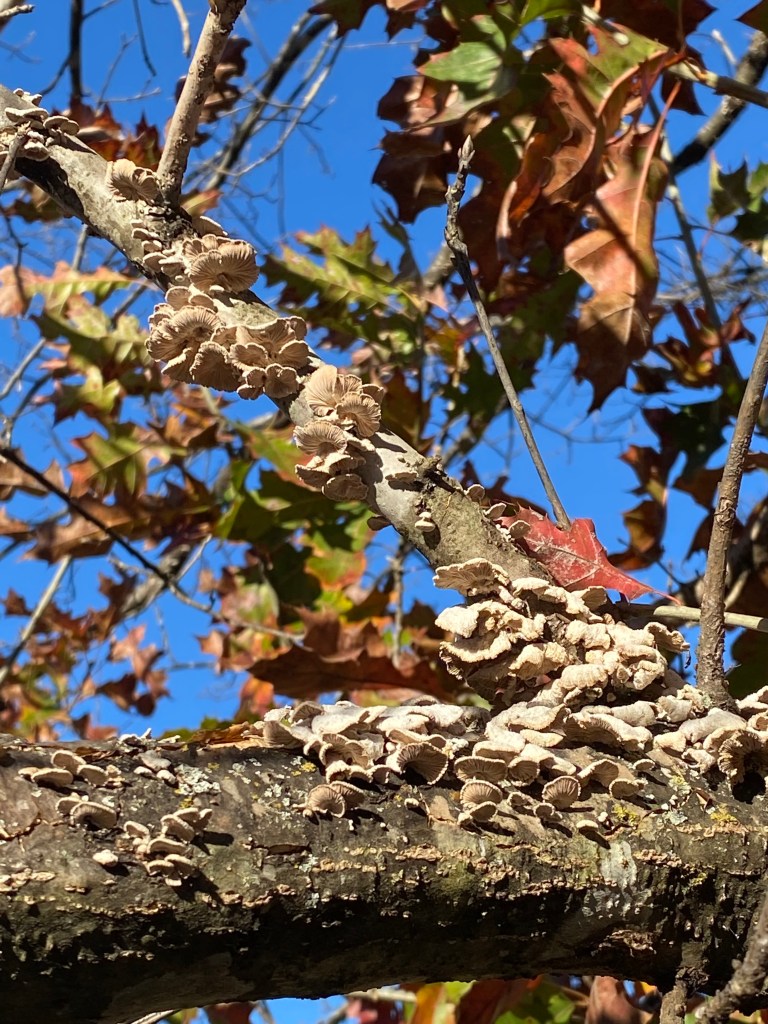
It’s pretty typical to find these small white mushrooms on both tree branches and trunks on various tree types in the Austin area.
Some common characteristics of this type of fungal infection are large open wounds (cankers) with “sloughing” or shedding bark exposing the heartwood of the tree. You may notice piles of bark accumulating at the base of your tree as a sign.
Unfortunately, you may also start to notice sections of defoliation in the canopy or a large number of dead tips protruding out from dense stress related new growth/foliage known as “water sprouts” as the bark continues to recede. You may also notice an increase in frequency of limb drop.
Split gill is considered a type of “white rot” which does affect the sapwood and disrupts the bark and cambium of the tree. Once the cambium (where cells divide) is gone, it’s gone for good.
The freeze, drought, climate change and numerous other factors like these fungal infections are exacerbating the number of hazardous limb failure and the problem of urban canopy/tree loss.
In his book, Dr. Lully describes common split gill as an “aggressive colonizer” and “indicator of jeopardized branch stability, currently or in the near future”, which was frequently corroborated by dozens of my customers this year.
Depending on the size of the tree/tree limbs and their proximity to targets (people, property and activities) there is a varying degree of risk. Again, please seek a qualified professional to address any questions or concerns you may have for your trees. ‘
I do strongly believe in tree risk assessment and weighing mitigation options in order to salvage trees that have a fighting chance and that are of low risk to people or property. Removal of trees should always be a last resort because of the many benefits that our trees provide.
What I generally recommended is to proactively create an ongoing plant health care plan for your trees that does the following: amends/fixes your soil, addresses compaction and drainage, addresses pest/disease management and executes best management pruning practices to avoid spreading disease and damaging trees.
This is of course in addition to having obvious defects in the trunk, branches and root system assessed for risk, its not possibly to have zero risk in any tree.
As tree enthusiasts, tree managers, homeowners and arborists we must do our best to manage our collective forest for safe and future enjoyment while also striving to educate our communities about urban forestry stewardship!
The following article is based on field observations, please feel free to reach out with any constructive criticisms, thank you!
 Big Tree Shady City
Leave a comment